|
Program & Admission Information - Montpellier, France
|
|
|
|
|
The instruction of functional language skills in an action-oriented approach is at the heart of teaching methodology. Students will learn the skills needed to communicate in real life situations. Exercises to improve fluency and accuracy are combined with communicative small-group activities. Close attention is paid to the degrees of control in the practice leading from initial presentation of the new language towards realistic communicative use of that language.
|
|
|
|
|
|
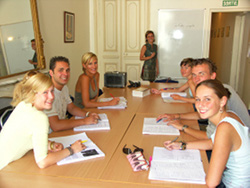 In order to reach your language targets, our French language school provides specially trained teachers whose mother tongue is French. All our teachers hold a special degree to teach French as a foreign language. Their experience, and dynamic stimulating way of teaching in connection with the interactive, direct method will enable you to progress quickly. Our working atmosphere is serious, but relaxed.
The pragmatic and effective method provides you with all necessary language skills and cultural awareness enabling you to communicate in the French language. We emphasis oral communication of the modern French language without neglecting the written aspects. Our teachers use a wide variety of authentic documents obtained from newspapers, TV news and documentaries as well as radio, involve all our students actively in the classroom.
Also, we keep the number of students per course low (maximum 10 students), because only small class sizes allow for the active participation of each student. This also allows our teachers to follow each students progress closely and provide individual help.
If a French language course level is too easy or too difficult for you, or if you progress faster or slower than the other students in your group, no problem. We will change you to a different level which suits you better.
|
|
|
|
|
We ask our students to arrive at 8:00 am only on the first day to take part in a presentation of our French language school. During this presentation, you will receive the school folder with lots of information for your stay including a map of Montpellier and the school Guide.
After the presentation you will be introduced to you French teacher and begin your studies. In the afternoon of your first day, there will be an orientation tour of Montpellier showing you the beauty of our city and providing you with additional practical information.
|
|
|
|
|
Orientation:
NRCSA program will held an Orientation session locally. The orientation designed to provide students with important information about immigration, law of the countries, and the services offered by the school. The orientation program also introduces you to the educational and cultural atmosphere and provide an opportunity to meet other students
|
|
|
|
|
First Day:
All levels of the language are accepted, from complete beginner to advanced, and your exact level is determined by a placement test to make sure we put you in the right class. One of the unique things about the NRSCA program is the ability to combine the language classes with an extensive choice of culture classes. In addition to the language classes, we also include our culture and social events program in the afternoons for students to interact with other student and learn about the culture.
|
|
|
|
|
|
|
|
|
|
|
 Standard French Course
20 lessons per week. Available for students at any level, beginning to advanced. Each lesson has a duration of 45 minutes. The courses take place in the morning, Monday-Friday and include broadening of grammar, structure and vocabulary skills; intensive training in oral and written expression; and the study of French culture and civilization.
|
|
|
|
Intensive French Course
30 lessons per week. Available for students at any level, beginning to advanced. Each lesson has a duration of 45 minutes. The courses take place in the morning, Monday-Friday and include broadening of grammar, structure and vocabulary skills; intensive training in oral and written expression; and the study of French culture and civilization.
In addition, this French course contains 10 French lessons of special training in oral communication.
|
|
|
|
|
The 20 lesson Standard Course takes place from 09:00 a.m. to 12:15 p.m. (incl. 15 minutes break) – Mondays from
10:00 a.m. to 01:15 p.m.
The 30 lesson Intensive Course and the 20 + 10 lesson Standard Course + Business French have additional classes for
3 afternoons (usually Tuesday, Wednesday, Thursday) from 01:00 p.m. to 03:30 p.m.
|
|
|
|
|
Combine Standard French Course and Tutor
This French course offers in conjunction with the Standard Course the acquisition of special business vocabulary and business expressions in a wide range of topics.
Required Level : Minimum Intermediate.
|
|
|
|
|
French Semestre
20 lessons per week. Available for students at any level, beginning to advanced. Each lesson has a duration of 50 minutes. The courses take place in the morning, Monday-Friday. Available for all students is self study in the multimedia learning center, and audio, video and computer assisted language learning resources These elements are all available for students to work independently.
DELF and DALF exam preparation is possible in these courses.
|
|
|
|
|
Private French Classes
It is possible to take 20, 25, 30 hours per week. Starts every Monday for all levels.
Tailored French course ideal for those with only a little time. General French or specialized topics (e.g. business, hotel management, tourism, marketing, exam preparation).
|
|
|
|
| |
|
Admissions & Academic Credit
|
|
|
|
|
Students age 18 years and older are welcomed regardless of educational background, occupation or nationality. No previous knowledge of French is required except where otherwise indicated.
|
|
|
|
|
|
Students seeking credit for study should check with their home school before registering. Generally, U.S. schools consider 15 hours of study to be equal to 1 semester credit.
|
|
|
|
|
|
|
|
|
|
|
A School Certificate will be issued to students provided he/she has attended the course regularly. The Certificate describes quite precisely level of language competence the student has reached in language training in the following areas: listening, speaking, reading and writing.
|
|
|
|