|
Spanish Language & Culture Programs in Cuernavaca, Mexico
|
|
|
|
|
|
|
 Since 1980, the Intensive Spanish Program has helped our students take leaps and bounds in their Spanish studies no matter what level of previous Spanish they have. Students are completely immersed in the culture and language which are woven intricately into the linguistic process.
Our program strives to make Spanish a part of your life. It will challenge you with comprehensive yet manageable classes and courses which will help you gain better fluency and knowledge of the Spanish language.
Our program strives to make Spanish a part of your life. It will challenge you with comprehensive yet manageable classes and courses which will help you gain better fluency and knowledge of the Spanish language.
Our goal is to maximize your usage of Spanish in a multicultural environment.
Advantages:
• No more than 5 students per class
• 6 hours a day, 5 days a week
• Native Spanish Speaking Teachers
• Complete Cultural Immersion
• Dynamic guided conversation workshops
• Complete flexibility
|
|
|
|
|
|
 Intensive Spanish Language Program
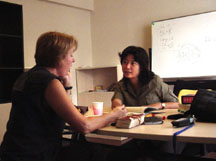
The Intensive Spanish Language Program offers the opportunity to experience an intensive study of Spanish, and Latin American culture for individuals whatever their interest or professional and educational career may be. The program consists of 15 hours weekly of small group Spanish classes with an emphasis on oral skills, plus 15 hours weekly of larger lecture style grammar classes, social science and humanities courses on Latin America and Hispano-America. These Latin American Studies Courses are an integrated part of the language study curriculum.
The program is designed to develop conversational fluency in the shortest time possible. Classrooms are maintained with no more than five students and a "Total Immersion" Spanish-only policy is maintained. The program is dedicated to meet the individual's needs, profession and Spanish proficiency level.
|
|
|
|
|
|
 Intensive Spanish Executive Programs
In response to the increasing demands of business executives and cognizant of the special needs of corporate training programs, Universidad Internacional offers an extremely accelerated Intensive Spanish Executive Program. The program has been designed and developed to fit the busy schedules of business executives and managers by providing them with the advantage of intensive Spanish with the guarantee of communicating in Spanish within a short period of time. The program is designed for all levels from beginners to advanced, and for individuals or groups.
Intensive Spanish Executive Program consists of 15 hours weekly of Spanish Tutorial one-on-one combined with 30 hours weekly of Group Spanish and Cultural Studies.
|
|
|
|
|
 Cultural Studies include cross-cultural training in business, conversational workshops that focus on professional work situations, and other topics such as Mexican history, politics, economy, sociology, psychology, health, literature, and art.
The one-on-one individual Spanish language classes are designed according to the participant's interests, level of Spanish and academic and/or professional needs. Classes usually begin every Monday throughout the year. It is recommended that students arrive on the Friday prior to beginning classes. On Saturday, the school gives an orientation class, a placement test and oral interview to determine the student´s Spanish level. A minimum of two weeks is recommended. The starting date for the Intensive Spanish Executive Program can be tailored according to each individual's work schedule.
Executive Suite and Lounge
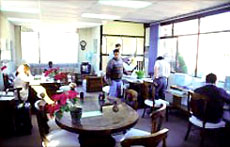
Executives are usually extremely busy and often need to be in contact with their home offices. The school provides a special suite and lounge for the exclusive use of participants in the Executive Programs. The Executive Suite has a full time bilingual assistant who is available to help participants in the Program with any arrangements they need. Also available in the suite are telephones, e-mail, fax machine, computer, ongoing news reports, printer, private work areas, and a lounge.
|
|
|
|
|
Intensive Spanish Language Program for Health Care Professionals
Through the Intensive Spanish Health Care Program, health care professionals will develop skills and knowledge that will enhance their effectiveness with Spanish-speaking patients or clients. Terminology and information specific to the health care field is part of the curriculum.
The Intensive Spanish Language Program for Health Care Professionals is designed to meet individual's interest, profession and Spanish proficiency level. It emphasizes medical and psychological terminology, vocabulary and activities that fit the health care professional's needs to not only communicate with the Hispanic population, but also understand its cultural issues.
A typical daily schedule begins at 8 am and ends at 4 pm, Monday through Friday: 1) Three hours of Spanish classes with no more than five students per class. 2) Two hours of Latin American courses in social sciences and humanities. 3) One hour of lectures (Conferencia) in History of Medicine, Mexican Medical Institutions, Traditional Medicine and other subjects in health care. 4) Two hours of optional classes based on individual needs and interests.
|
|
|
|
|
|
 Intensive Spanish Language Program for Professionals
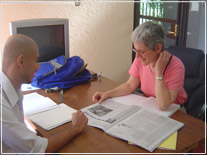
We recognize that some students are learning Spanish not just because it interests them, but also because they need it for a specific purpose. For this reason, we offer several specialized programs that provide specific vocabulary and coursework that will help you reach your goals and communicate more effectively in the Spanish speaking world. If you require a program focusing on a different field or with different vocabulary, we can modify any program to meet your needs. To make sure we meet all your requests, it is best if you contact us at least 2 weeks prior to your arrival.
Our program for specific purposes has the same structure of the Intensive Spanish Program with the specific vocabulary and situation related to your needs.
Business professionals
Social Workers
Lawyers
|
|
|
|
|
Study & Internship Program
This Study & Internship program in Cuernavaca combines a minimum 4 week Standard Group Spanish Study program followed up with a minimum 8 week Internship Work Experience placement in the community.
Internship placements are available in the following fields:
-Medical Personnel
-Social Work
-Business and Economics
-Education (Not available during sumer season)
-Hotel and Restaurant Management
-Mexican Criminal Justice
-Art (music, dance)
-Sports
-Radio and Television Broadcasting
-Environmental Awareness
-Anthropology
-Computer Science
-Others may be available upon request
For more information about this program, contact us!
|
|
|
|
|
|
|
|
|
|
The Children's Program (5 to 12 years old)
The Children's Program is a fun way to start learning Spanish at a young age. There are two main components of the program:
* Academic activities.
* Recreational activities.
Academic Activities
Based on multiple teaching methods, the program focuses on communicative skills, while using an array of educational materials that will lead children to learn Spanish effectively. Academic focuses include:
* Oral and auditory skills, vocabulary acquisition.
* Reading and correct pronunciation.
* Hand-writing, drawing, cutting, modeling, etc.
* Homework practice (optional).
Recreational Activities
Children learn Spanish while participating in:
* Role playing with social integration.
* Hands-on activities such as mask making, pinatas, ceramics and kite decoration/flying.
* Sports: Swimming, Soccer, and more.
* Theater and oral expression.
* Workshops: Songs, Music, and Photography.
* Meetings and games with Mexican children of similar ages.
* Excursions and cultural events: Visits to diverse recreational and educational centers.
The daily schedule will consist of 3 hours of Spanish classes in small groups, 1 hour lunch break and short rest time, and 2 hours of recreational activities. Parents will receive reports detailing their child's progress in the program.
A team of 20 teachers, supervisors, coordinators, and technical staff operate the Children's Program. They are all carefully chosen, and have significant experience in accommodating the needs of children. This program is available for children who are traveling with a parent or parents enrolled in a language program at the Universidad Internacional.
|
|
|
|
|
Components:
Intensive Spanish Language Class (3 hrs.) After taking a brief entrance exam and oral interview with a Spanish professor, students are placed in small groups according to their previous level of Spanish fluency, their ability to communicate, and their interests. We subscribe to the "Group 5 System" in which no more than 5 students are assigned to a professor. This guarantees that our students receive the attention they need and encourages interaction among the group. This class focuses on 4 main skills: speaking, listening, reading, and writing.
Latin American or Grammar Courses (2 hrs.) This is a flexible option that allows the students to choose from an assortment of classes in the following areas of study: Art, Business, Education, History, Latin-American Studies, Linguistics, Literature, Political Science, Psychology, Religion, and Spanish grammar.
Cultural Lectures, Idiomatic Expressions or Conversation (1 hr.)
This component is designed to improve students' listening and conversational Spanish Language skills and cultural awareness by corrected discussions on topics like holidays, festivities, and family life.
Students are encouraged to compare and contrast their own culture with their experiences in Mexico. Students are taught idiomatic expressions that will help them interact and better understand the culture in which they are immersed.
|
|
|
|
|
Day - At - A - Glance
8:00 – 9:00 Spanish Classes
9:10 - 10:00 Spanish Classes
10:10 - 10:55 Spanish Classes
10:55 - 11:15 Break
11:15 – 12:00 Latin American or Grammar Courses
12:10 - 13:00 Latin American or Grammar Courses
13:10 - 14:00 Conversation or Culture Classes
Note: classes may also be in the afternoon from 2:00 pm to 6:00 pm for Group or one- on-one classes or students could participate in the afternoon activities.
**Day-At-A-Glance is a sample day and will vary depending on enrollment, time of year, lodging, etc. It is designed to show content rather than precise scheduling.
|
|
|
|
|
Orientation:
NRCSA program will held an Orientation session locally. The orientation is designed to provide students with important information about immigration, law of the countries, and the services offered by the school. The orientation program also helps you to acquaint to the educational and cultural atmosphere and provide an opportunity to meet other students.
|
|
|
|
|
First Day:
With regards to the program, all levels of the language are accepted, from complete beginner to advanced, and your exact level is determined by a placement test to make sure we put you in the right class. One of the unique things about the NRSCA program is the ability to combine the language classes with an extensive choice of culture classes. In addition to the language classes, we also include our culture and social events program in the afternoons for students to interact with other student and learn about the culture.
|
|
|
|
| |
|
Admissions & Academic Credit
|
|
|
|
Students age 17 years and older are welcomed regardless of educational background, occupation or nationality. Students under the age of 17 must be accompanied by an adult unless registered for the Teen program. No previous knowledge of Spanish is required except where otherwise indicated.
Students desiring credit for their study programs should contact their home school or request the NRCSA Credit Fact Sheet. Generally, U.S. universities consider 15 hours of study to be equal to 1 semester credit.
The University is accredited by the Universidad Autónoma del Estado de Morelos (UAEM as of 3/18/93 code 92-I-1). All of its programs have been formally recognized by the Commission on Higher Education of the Middle States Association of Colleges and Schools in a recent evaluation of the SUNY-Brockport Study Abroad Program at the school (1996).
Hundreds of U.S. universities have given credit for study at this institute based on preauthorization. Generally, one credit is given for each week of Spanish study (20 hours.) Grades consist of an A-F or Pass/Fail. The instructors keep a daily record of each student's performance and of the material covered in class. A final examination can be given upon request. A written summary of your course work and individual achievement can be provided for a student requesting credit. Credit can also be given for mini courses. One credit is usually given for each 16 hours of class. A 2-3 page report must be written if the mini course is to be taken for credit. The critique, composed in Spanish, must evaluate both course content and the instructor's performance.
For more information about academic credit in Spanish speaking countries, please click here.
For general information on academic credit, please click here.
|
|
|
|
|
|
|